Thursday, December 31, 2009

Home based MFR managements for pelvic floor dysfunctions: Part V

Self Myofascial release for chronic pelvic floor pains
AJIMSHAW’s Approach part III
SPECIFIC SESSIONS
II. Internal Pelvic Release

Fascial tightness of the perineum and its structures have major role in pelvic floor dysfunction and pain. Inorder to balance the pelvic floor it should be managed both externally and internally. This session explains the techniques of ‘Internal Pelvic Release’.
To understand the importance of ‘Internal Pelvic Release, have a look at the below picture. The “X” marked are trigger points in pelvic floor muscles and the reddish areas are the referred pain due to the trigger points. ‘Internal Pelvic Release’ is the most advanced way to release these triggerpoints.


60-80% DID NOT RECEIVE AN ACCURATE DIAGNOSIS (GPWPP 2007)

Causes of Pelvic Myofascial Trigger Points
Excessive tension on muscle fibers
Straining
Habitual tightening
Trauma as in pregnancy, injury
Inflammation


Types of Pelvic Floor Muscle Trauma
Severe trauma from accidents of falls (coccygeal injury)
Urological or gynecological surgery
Repetitive minor trauma from bicycle seats, uncomfortable chairs
Childbirth

Inflammation of the Pelvic Organs
Infections eg:- prostate, bladder, vaginal
Endometriosis
Inflammatory bowel disease/IBS

Feet position and Pelvic Dysfunction
Inward or outward rotated feet can lead to muscle imbalance and tension in the hip rotators causing abnormal tension in the pelvic nerves (Pudental Nerve)

Correct your Foot deformity and improve your pelvic floor function!
THE PERINEUM

The perineum and perineal body lies between the vagina and the anus on a female and between the bulb of the penis and the anus on a male. The Perineal body is essential for the integrity of the pelvic floor, particularly in females. Its rupture during delivery leads to widening of the gap between the anterior free borders of Levator Ani muscle (pelvic floor muscles) of both sides, thus predisposing the woman to prolapse of the uterus, rectum, or even the urinary bladder.

The following muscles converge and are attached to the perineum:
External anal sphincter
Bulbospongiosus
Superficial transverse perineal muscle
Anterior fibers of the levator ani
fibers from external urinary sphincter
Deep transverse perineal muscle


Because of different reasons myofascial dysfunctions and trigger point developments are very common and most of the time these trigger points will be unidentified and its importance is being ignored. Result; increasing pelvic floor dysfunctions and pain.

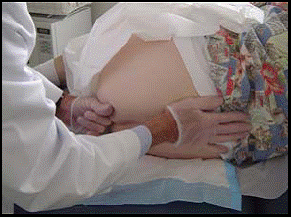
As we have discussed in the previous sessions the success of ‘Self Myofascial Release’ lies in the ability of finding the exact sites of myofascial restrictions and trigger points. Palpation with your finger tips and application of firm pressure over 90 seconds is the basics of SMFR.


The picture illustrates the techniques of palpation of myofascial restrictions and trigger points. When you reach the restricted area you can find or feel nodules, bands or thickness. Pressure on this area will produce pain over there and you will feel pain radiating to adjacent or distant areas which is called radiating pain.

Trigger points in the perineum and vulva.
The picture below is a true representation of myofascial restrictions and trigger points in the perineal area and the vulva(female external genitalia) the ‘blue’ shades represents triggerpoints which can be approached externally and ‘yellow’ shades represents triggerpoints which only be approached internally. Every person’s myofascial restriction patterns and dysfunctions vary. You have to examine each of this area using the below picture as reference. On palpation if you feel pain marks that area with a non irritant marker.
Vulva with triggerpoints
(Save this picture or take a print out for reference during SMFR)

Common Sites of Connective Tissue Restrictions in pelvis

Steps to follow for Perineal SMFR

Perineal SMFR is a technique which slowly and gently releases the myofascial trigger points and restrictions around the vagina, perineum and rectum.
CAUTIONS:
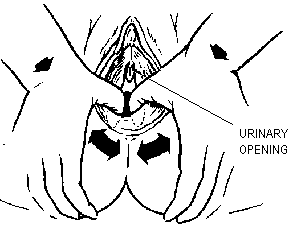
Avoid the urinary opening (see diagram) to prevent urinary tract infections.
Do NOT do Perineal SMFR if you have active herpes lesions or any other infections, as you could spread the infection to other areas.
General Hints:
The first few times it’s helpful to use a mirror to find the vagina and perineum and see what they look like.
If you feel tense, take a warm bath or use warm compresses on your perineum for 5 to 10 minutes.
If you have had an episiotomy with a previous birth, concentrate part of your SMFR on that area, Scar tissue isn’t as stretchy as the rest of your skin and needs extra attention.
After Perineal SMFR, tone up the muscles in the vagina by practicing the pelvic floor (Kegel) exercises regularly.
Directions:
1. Wash your hands.

2. Find a private, comfortable place and sit or lean back in a comfortable position.
3. Put a lubricant such as KY Jelly, vitamin E oil, or pure vegetable oil on your thumbs and around the perineum if the skin is very dry/ scaly. Care should be taken for extra hygiene and use lubricant in a lesser quantity. For Perineal SMFR you can use the tools which we have discussed earlier (nobbers, myoballs etc)
The techniques
4. a. Pelvic diaphragm Release

Use the below description if your partner or care giver can help you other ways apply pressure over the prescribed area by using appropriate tools.

• Lie on your back in a comfortable position
• Let your partner to sit at side of pelvis to be treated, facing your head
• Bend your knee and hip and introduce index & middle fingers medial to ischial tuberosity (the ischiorectal fossa)[when you are palpating the area as shown in the picture above you can feel a bony prominence over there]
• Take a deep inspiration and during exhalation, press fingertips superiorly as shown I the picture in a slow and sinking way.
• Maintain this position, during next exhalation, continue to follow and press fingers more superiorly (and deeply)
• Repeat several cycles
• RE-TEST
• Alternately you can use myo balls, nobbers etc for this release.

4.b. Perineal SMFR

Trigger points (which cause referred pain in persons with chronic pelvic pain/ic) in the perineum can refer pain and sensation to the rectum, vagina, and site of palpation. It is very important that you have to release this area by SMFR.
Apply pressure to the perineal body ----the technique is far gentler, for the tissue and muscles here can be very sensitive. Take it easy when applying pressure to perineal body; find out the restrictions and trigger points, apply pressure and gradually sink into the area, hold there for 90 second time, concentrate on your breathing, try to sink down during deep exhalation. Treat multiple areas as necessary. Remember you are trying to soothe pain, feed the area blood and oxygen, not beat it into submission.
You will need either of a comfortable tool as we mentioned earlier. If you don't have one apply pressure using finger tips or a dilator until you can purchase one. It is important that you find a comfortable place to lay down where you will be ensured privacy.(Note: perineal SMFR is especially helpful before and after sexual activity.)If you use gloves they should be non-latex and lubricants should be paraben-free and have no propylene glycol which can irritate the tissue. Check labels.

4. c. Vulvar SMFR

The SMFR procedure for the vulva is same as for other SMFR. But in vulva you have to check for restrictions in a systematic manner. There can be inactive or multiple fascial restrictions. So palpate areas by dividing it into multiple sections (refer the trigger point diagram above and compare)

4. d. Vaginal SMFR
For vaginal SMFR a clean hand with or without a sterile glove is enough. Our goal is stretching the pelvic floor muscles through either vagina or rectum. Use your finger (index finger, some finds comfort by using both the thumbs together for the opposite sides, select as per your convenience)

Stretch the vaginal wall with an aim to go deep and find out the restrictions at the internal pelvic floor muscle. We used to call his as “Palpation through stretching” move around the vagina while maintaining the stretch, apply firm pressure to the restrictions or trigger points for 90 seconds and repeat the treatment.

This treatment is especially useful for all type of female genital discomforts and pain especially after the menopause.
Follow the pictures


Home program for painful intercourse


SELF TREATMENT: URGENCY/ FREQUENCY


Use the picture “Vulva with trigger” point as reference

4. e. Rectal SMFR

Rectal SMFR is indicated for those females who are having chronic pelvic/sacral/coccygeal pains and for males. The techniques of application is same like the ‘vaginal SMFR” provided that a sterile glove should be used always. Most of the clients finds it difficult , but the difficulty depends on your physique. A partner can help you in this regards.


SUMMERY

Success in the management of all painful pelvic, gynecological conditions needs multidisciplinary approach. You need to remain active. Performing some back exercises and pelvic floor exercises immediately after the release is found to hasten the improvement. So be active and be cool. Don’t forget that there will be an increase in discomfort when you are starting the SMFR, don’t give up it’s a short period after that you will praise me.

My advice is be cool, be active and be a master of pelvic SMFR. If you are having any queries please contact me via scebcaptmfr@gmail.com.

Joining/ making pelvic pain interest groups are always good. So plan for that too. Discuss these topics among you. Please inform other pelvic floor dysfunction patients about this.

Saturday, December 5, 2009

Self Myofascial Release

What is Self Myofascial Release

Definition of Self Myofascial Release (SMR)
Neurologically release adhesions, tender spots or “knots”

1. Contractile fibers can be inhibited from releasing to normal resting length
2. This can be due to injury, muscle imbalances, muscles being overworked
3. Tension helps golgi tendon organ stimulate muscle spindles to relax

Protocol for SMR
Using Styrofoam roller, stick, or tennis balls; find knots and hold position as close to tension area as possible

1. Breathe; hold position for 30-45 seconds or until tension dissipates
2. Repetition of SMR makes it easier to bear and reduces tender spots in general
3. Potential contraindications
a. Large bruises, phlebitis, varicose veins, open wounds, undiagnosed lumps, and skin infections, circulation issues

Benefits of SMR
Perfect for clients who feel tension but whose muscles do not need stretching/lengthening
Releasing knots can facilitate blood flow and circulation
Releasing knots can facilitate proper firing patterns

SMR for Cycling
Potential tender spots/adhesions

1. Lower extremity
a. Lateral chain: calf; peroneals; bicep femoris; IT band; piriformis
b. TFL; anterior hip/quads

2. Upper extremity
a. Lats; teres major; upper middle back; pecs/anterior delts

Program Design


Sequencing release/stretching/strengthening

1. Lower extremity
a. SMR lateral chain
b. Stretch lateral muscles/external rotators
c. Strengthen medial muscles/core
- lateral lunges
- core with adductors
d. Check gluteus medius integrity

2. Upper extremity

a. SMR upper middle back
b. Stretch anterior muscles
c. Mobility/strengthening exercises for upper middle back

Suggested Reading
1. Alter, Michael J. Science of Flexibility. Human Kinetics, 1996.
2. Biel, Andrew. Trail Guide to the Body. Harcourt Brace & Co., 1943.
3. Forem, Jack. Healing with Pressure Point Therapy. Penguin Putnam Inc., 1999.
4. Myers, Thomas, W. Anatomy Trains: Myofascial Meridians for Manual and Movement Therapists. Churchill Livingstone, 2001.

How to do self Myofascial Release

SELF-Myofascial Release Techniques Using Foam Rollers

Self myofascial release techniques (SMRT), although not new, have become more and more prominent amongst athletes and fitness enthusiasts alike.
Both allopathic and alternative Therapists have embraced the use of myofascial release massage to reduce chronic pain and rehabilitate a range of injuries. Some therapists claim a long list of benefits, from curing tennis elbow to IBS relief. While some claims may be contentious, it seems likely that many sports men and women can benefit from this regenerative therapy.
It’s important to understanding two key terms in order to appreciate how self myofascial release technique acts favourably on the body. They are ’fascia’ and ’trigger points’. Both are explored below before moving on to some sample self myofascial release exercises.

Fascia & Trigger Points
Fascia is a specialized connective tissue layer surrounding muscles, bones and joints and gives support and protection to the body. It consists of three layers - the superficial fascia, the deep fascia and the subserous fascia. Fascia is one of the 3 types of dense connective tissue (the others being ligaments and tendons) and it extends without interruption from the top of the head to the tip of the toes (1).
Fascia is usually seen as having a passive role in the body, transmitting mechanical tension, which is generated by muscle activity or external forces. Recently, however some evidence suggests that fascia may be able to actively contract in a smooth muscle-like manner and consequently influence musculoskeletal dynamics (2).

Obviously, if this is verified by future research, any changes in the tone or structure of the fascia could have significant implications for athletic movements and performance. This research notwithstanding, the occurrence of trigger points within dense connective tissue sheets is thought to be correlated with subsequent injury.
Trigger points have been defined as areas of muscle that are painful to palpation and are characterized by the presence of taut bands. Tissue can become thick, tough and knoted. They can occur in muscle, the muscle-tendon junctions, bursa, or fat pad (3). Sometimes, trigger points can be accompanied by inflammation and if they remain long enough, what was once healthy fascia is replaced with inelastic scar tissue.
It has been speculated that trigger points may lead to a variety of sports injuries - from camps to more serious muscle and tendon tears. The theory, which seems plausible, is that trigger points compromise the tissue structure in which they are located, placing a greater strain on other tissues that must compensate for its weakness. These in turn can break down and so the spiral continues.
According to many therapists, trigger points in the fascia can restrict or alter the motion about a joint resulting in a change of normal neural feedback to the central nervous system. Eventually, the neuromuscular system becomes less efficient, leading to premature fatigue, chronic pain and injury and less efficient motor skill performance. An athlete's worst nightmare!


What causes a trigger point to form?

The list of proposed causes includes acute physical trauma, poor posture or movement mechanics, over training, inadequate rest between training sessions and possibly even nutritional factors (4,5).
Self myofascial release is a relatively simple technique that athletes can use to alleviate trigger points. Studies have shown myofascial release to be an effective treatment modality for myofascial pain syndrome (6,7,8), although most studies have focused on therapist-based rather than self-based treatment.

Self Myofascial Release Exercises

For these exercises you will need a foam roll You can also get them from anywhere that sells sports medicine or physical therapy supplies.


Adductor Self Myofascial Release

1. Extend the thigh and place foam roll in the groin region with body prone (face down) on the floor. 2. Be cautious when rolling near the adductor complex origins at the pelvis. 3. If a “tender point” is located, stop rolling, and rest on the tender point until pain decreases by 75%.


Hamstring Self Myofascial Release


1. Place hamstrings on the roll with hips unsupported. 2. Feet can be crossed so that only leg at a time is one the foam roll. 3. Roll from knee toward posterior hip. 4. If a “tender point” is located, stop rolling, and rest on the tender point until pain decreases by 75%.


Quadriceps Slef Myofascial Release

1. Body is positioned prone (face down) with quadriceps on foam roll 2. It is very important to maintain proper core control (abdominal drawn-in position & tight gluteus) to prevent low back compensations 3. Roll from pelvic bone to knee, emphasizing the lateral (outside) thigh 4. If a “tender point” is located, stop rolling, and rest on the tender point until pain decreases by 75%.


Iliotibial Band Self Myofascial Release

1. Position yourself on your side lying on foam roll. 2. Bottom leg is raised slightly off floor. 3. Maintain head in “neutral” position with ears aligned with shoulders. 4. This may be PAINFUL for many, and should be done in moderation. 5. Roll just below hip joint down the outside thigh to the knee. 6. If a “tender point” is located, stop rolling, and rest on the tender point until pain decreases by 75%.


Upper Back Self Myofascial Release

1. Place hands behind head or wrap arms around chest to clear the shoulder blades across the thoracic wall. 2. Raise hips until unsupported. 4. Stabilize the head in a “neutral” position. 5. Roll mid-back area on the foam roll. 6. If a “tender point” is located, stop rolling, and rest on the tender point until pain decreases by 75%.

General Guidelines
• Spend 1-2 minutes per self myofascial release technique and on each each side (when applicable).
• When a trigger point is found (painful area) hold for 30-45 seconds.
• Keep the abdominal muscles tight which provides stability to the lumbo-pelvic-hip complex during rolling.
• Remember to breathe slowly as this will help to reduce any tense reflexes caused by discomfort.
• Complete the self myofascial release exercises 1-2 x daily.

CONTRAIDICATIONS: Please discontinue exercises and consult your phycisian if you are experiencing sharp pains during foam rolling. Also consult your doctor if you are pregnant, healing from fractures or surgery, have been diagnosed with osteoperosis, rhumatoid arthritis, varicose veins or other chronic conditions.

References

1) Scanlon, V.C., and Sanders, T. Essentials of anatomy and physiology, 3rd edition. Canada: F.A. Davis Company. 2002
2) Schleip R, Klingler W, Lehmann-Horn F. Active fascial contractility: Fascia may be able to contract in a smooth muscle-like manner and thereby influence musculoskeletal dynamics. Med Hypotheses. 65(2):273-7. 2005
3) Borg, S. et al. Trigger points and tender points. One and the same? Does injection treatment help? Rheum. Dis. Clinics of North America. 22(2). 1996
4) Vecchiet, L., Giamberardino, M.A., Saggini, R. Myofascial pain syndromes: clinical and pathophysiological aspects. Clin J Pain. 7 Suppl 1:S16-22. 1991
5) Saggini, R., Giamberardino, M.A., Gatteschi, L., Vecchiet, L. Myofascial pain syndrome of the peroneus longus: biomechanical approach. Clin J Pain. Mar;12(1):30-7. 1996
6) Hanten, W.P., Olson, S.L., Butts, N.L., Nowicki, A.L. Effectiveness of a home program of ischemic pressure followed by sustained stretch for treatment of myofascial trigger points. Phys Ther. Oct;80(10):997-1003. 2000
7) Hanten, W.P. et al. Effects of active head retraction with retraction/extension and occipital release on the pressure pain threshold of cervical and scapular trigger points. Physiotherapy Theory and Practice. 13(4). 1997
8) Hou CR, Tsai LC, Cheng KF, Chung KC, Hong CZ. Immediate effects of various physical therapeutic modalities on cervical myofascial pain and trigger-point sensitivity. Arch Phys Med Rehabil. Oct;83(10):1406-14. 2002

How to do Self Myofascial Release

Self Myofascial Release

Erector Spinae Stretch
Exercise Description: Erector Spinae Stretch
Classification: Self Myofascial Release
Instructions: 1. Position the client on the foam roller at the level of approx. T-2.
2. Instruct client to perform a drawing in and pelvic floor contraction to aid in spinal stabilization. 3. Once the client is positioned correctly, instruct them to roll slightly to one side (so that they are on the muscle that runs parallel to the spine and not the spine itself) and HOLD. 4. SLOWLY, the client should roll the foam roller down the side of the spine toward to pelvis, feeling for an area of increased tension.
5. Once found, the client should HOLD on this area for 30 sec - 1 min or until the muscle has relaxed about 50% (AVOID rolling over this trigger point area).
6. Once released, roll to another spot and HOLD


Gastroc Soleus Stretch
Exercise Description: Gastroc Soleus Stretch
Classification: Self Myofascial Release
Instructions: 1. Place foam roll under mid belly of lower leg.
2. Cross left leg over right leg to increase pressure (optional).
3. Slowly roll calve area to find the most tender area.
4. If a “tender point” is located, stop rolling, and rest on the tender point until pain decreases by 75%.


Lattisimus Dorsi SMR1 stretch
Exercise Description: Lattisimus Dorsi SMR1 stretch
Classification: Self Myofascial Release
Instructions: 1. Position yourself on your side with arm outstretched and foam roll placed in axillary area.
2. Thumb is pointed up to pre-stretch the latissimus dorsi muscle.
3. Movement during this technique is minimal
4. If a “tender point” is located, stop rolling, and rest on the tender point until pain decreases by 75%.


Lattisimus Dorsi SMR Stretch

Exercise Description: Lattisimus Dorsi SMR Stretch
Classification: Self Myofascial Release
Instructions: 1. Start in a side lying position with arm outstretched and thumb facing upward.
2. Place the foam roll in the axillary area.
3. Slowly move back and forth to find the most tender area.
4. Once identified, hold tender spot until the discomfort is reduced by at least 75%.
5. Progress to the next tender spot.
6. Repeat directions on opposite side.


Pereonal SMR Stretch
Exercise Description: Pereonal SMR Stretch
Classification: Self Myofascial Release
Instructions: 1. Position yourself on your side with elbow under the shoulder, opposing hand placed in front of the body and opposite leg bent forward to help stabilize.
2. Position the roller on the peroneals (lateral gastroc/soleus region).
3. Leave hip on the floor.
4. Activate the core/glutes by bracing and squeezing.
5. Raise the hips upwards increasing the pressure on the lower calf.
6. Roll in either direction until a “tender point” is found, hold on that point until you feel the tenderness release by approx 75%.
7. Muscles are 3 dimensional, so don’t just roll in the same plane-up & down. You are allowed to move across the peroneal also.
8. Don’t continually roll back and forth quickly, this will antagonize the muscle and have the opposite effect we are looking for.
9. Stop on the tender point until tenderness eases.

Rhomboid SMR Stretch
Exercise Description: Rhomboid SMR Stretch
Classification: Self Myofascial Release
Instructions: 1. This serves as a GREAT THORACIC MOBILITY TECHNIQUE AS WELL. Preparation
2. Cross arms to the opposite shoulder to clear the shoulder blades across the thoracic wall.
3. While maintaining abdominal Draw-In position, raise hips until unsupported.
4. Stabilize the head in “neutral”.
5. Roll mid-back area on the foam roll. 6. If a “tender point” is located, stop rolling, and rest on the tender point until pain decreases by 75%.


Sternocleidomastoid SMR Stretch

Exercise Description: Sternocleidomastoid SMR Stretch
Classification: Self Myofascial Release
Instructions: 1. Standing beside a wall place roller against the wall and gently position the side of your neck against it.
2. Tilt the roller on a slight angle with the front being lower than the back. navel and squeezing your glutes. Also keep the scapulae retracted.
3. Apply a small amount of pressure to the roller in the sternocleidomastoid area, gently move it around/up & down that area until a tender point is located.
4. Stop on the tender point, once it has eased by approx. 75% move on.


Tensor Fascia Latae SMR Stretch
Exercise Description: Tensor Fascia Latae SMR Stretch
Classification: Self Myofascial Release
Instructions: 1. Body is positioned prone with quadriceps on foam roll.
2. It is very important to maintain proper Core control (abdominal Drawn-In position & tight gluteus) to prevent low back compensations.
3. Foam roll is placed just lateral to the anterior pelvic bone (ASIS).
4. If a “tender point” is located, stop rolling, and rest on the tender point until pain decreases by 75%.